

[ad_1]
There are various security options/gadgets in a contemporary automobile reminiscent of Air Luggage, Seatbelts, ABS and many others. that assist us attain our vacation spot safely. One such function that’s gaining numerous consideration each from the producers in addition to clients is Tire Strain Monitoring System or TPMS. Initially it was a luxurious function however excessive failure charges of sure manufacturers of tires within the U.S. again within the early Nineties (and a legislation following this incident) made auto producers so as to add TMPS function. However what’s Tire Strain Monitoring System? How Tire Strain Monitoring System works? We are going to see extra particulars about TMPS on this information.
Introduction
Tires are one of many vital elements of an vehicle. However sadly, they’re additionally probably the most ignored elements of the automobile by many house owners/drivers. A poorly inflated tire just isn’t solely a security subject but it surely additionally impacts the efficiency of the automobile, gas financial system and tire life.
Sustaining good (and correct) tire stress as per the producer’s options will result in a cushty journey. A tire can lose its stress because of any overseas objects reminiscent of nails, because of defective valves, unhealthy threads and even growing older tires.
Each automobile proprietor should recurrently monitor and preserve their automobile’s tire stress. To help them relating to this, a number of producers are integrating Tire Strain Monitoring System (TPMS) into the vehicles.
What’s Tire Strain Monitoring System (TPMS)?
TPMS or Tire Strain Monitoring System because the title suggests, displays the stress of all of the tires of a automobile and if any tire has low stress, it illuminates a warning gentle within the instrument panel. As per the TREAD (Transport Recall Enhancement Accountability and Documentation) Act of 2000, all new automobile within the U.S. from 2008 have to be geared up with a TPMS.
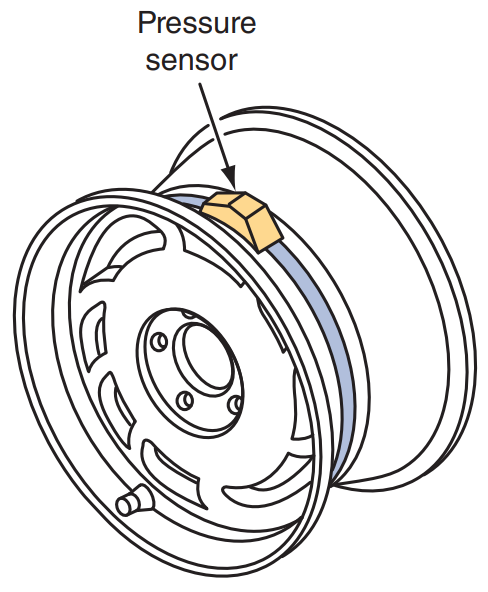
Some TPMS models have a sensor mounted on every valve stem whereas different models have a sensor strapped on to the middle of every rim with the primary sensing unit straight reverse to the valve stem.
No matter the place of the sensor, all of them detect the adjustments within the tire stress and if it falls down under sure worth, then the sensor models ship an RF Sign to a receiver, which often sits beneath the sprint. This receiver unit communicates the automobile’s ECU and prompts a warning gentle within the instrument panel.
Most trendy implementations of TMPS are literally higher as you’ll be able to see the precise tire stress of particular person tires proper within the instrument panel (often on a small multi-information show) or within the infotainment display screen.
Want for TMPS
Underinflated tires are one of many primary causes of accidents. When the stress is low, the tire will get broken and this failure will enhance the stopping distance or it can make the car go uncontrolled. The gap between the rim and the bottom is about 10cm that’s lined by air and tire layers. On account of this design, many drivers can not simply choose the tire stress correctly.
A Tire Strain Monitoring System helps the drivers by alerting them about underinflated tires. This method has been made necessary in a number of international locations/automobile markets such because the U.S, European Union, South Korea, Russia, Indonesia and many others. We hope that a number of extra international locations attempt to mandate this security function as shortly as attainable.
How Tire Strain Monitoring System Works?
With the intention to perceive how a typical Tire Strain Monitoring System or TPMS works, we have to first check out the several types of TPMS. We are able to divide the TPMS out there at this time into two varieties:
- Direct TPMS
- Oblique TPMS
In a direct TPMS, every tire has its personal stress sensor, connected both to the valve stem (from the within) or strapped on to heart of the rim. This stress sensor repeatedly displays the tire stress and the outcomes shall be proven on the motive force’s show.
An oblique TPMS however makes use of the ABS wheel pace sensor to measure the pace of all tires and compares the variations between them. This method just isn’t probably the most correct one and is appropriate for speeds as much as 60mph.
We are going to now discover extra about these two methods and perceive how Tire Strain Monitoring System works.
Direct TPMS
A Direct Tire Strain Monitoring System (dTPMS) has 4 tire modules connected to the again of the valve stem (from the within) of the 4 tires. A Tire Module is actually a mix of three elements.
- Piezo Resistive Strain Sensor
- Sign Processing/Conditioning IC
- RF Transmitter
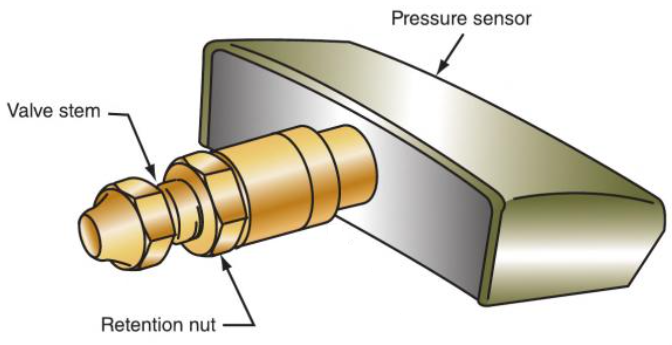
The stress sensor is a MEMS (Micro Electro Mechanical System) part made up of a silicon diaphragm sandwiched between two glass layers. Variations in stress will trigger the diaphragm to bow and different elements will measure this mechanical pressure.
In case you are conversant in Sensors and Transducers, their output may be very low, often in microvolts. The sign processing IC will amplify this sign and likewise convert it right into a digital worth.
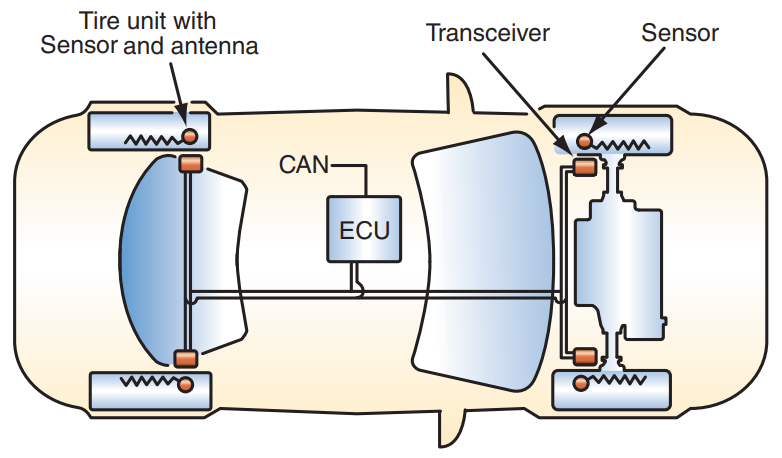
Subsequent, an built-in or discrete UHF transmitter (primarily based on SAW or PLL) will transmit the info to a receiver unit. A easy strategy to implement the TPMS receiver unit is to combine it with the distant keyless entry system as they share related performance (and likewise to scale back value). The receiver unit communicates with the ECU and shows the tire stress on the motive force’s show.
Oblique TPMS
Whereas Direct Tire Strain Monitoring System use particular person and devoted stress sensors with every tire, the Oblique Tire Strain Monitoring System (iTPMS) depends on current ABS (Anti-Lock Braking System) to detect tire stress. However how is that this attainable?
We all know that one of many essential jobs of the ABS Wheel Sensors is to detect its rotational pace. An Oblique TPMS makes use of this knowledge. Because the rotational pace of the tire is straight proportional to its stress, a tire with low stress has a decrease diameter.
iTPMS calculates the distinction between the rotational speeds of the tires and determines whether or not any tire has low-pressure or not.
Regardless that Oblique TPMS is less expensive to implement than Direct Tire Strain Monitoring System, the accuracy just isn’t that nice and it really works higher provided that the automobile has 4-channel ABS. You may simply add an Oblique TPMS to a automobile with 4-channel ABS system at considerably much less value than a Direct TPMS.
Conclusion
Tire Strain Monitoring System or TPMS is a security function on trendy vehicles that repeatedly displays the tire pressures and stories it to the motive force if any tire is underinflated. We noticed the essential of TPMS, several types of TPMS (direct and oblique) and likewise how Tire Strain Monitoring System works.
[ad_2]

.jpg)


0 Comments