

Welcome to the final word showdown between cobots and robots!
For many years, typical industrial robots have dominated the manufacturing house. They’ve supplied companies with automation options succesful taking up repetitive duties and decreasing handbook labor.
Extra not too long ago, collaborative robots stepped into the ring as a challenger to standard robots. They could look much like some typical industrial robots, however they’re lighter and simpler to make use of. Firms have began adopting cobots at a powerful price.
Which is best? Cobots or robots?
It is time to put the 2 robotic varieties in opposition to one another as soon as and for all.
Prepare for our head-to-head… sorry… arm-to arm showdown between cobots and traditional robots.
Let’s meet our contestants!
Contestant 1: Typical Industrial Robots
Within the first nook, we’ve got the traditional industrial robotic, a machine constructed for velocity and energy.
Industrial robots have been used for nearly 70 years in automated manufacturing processes. They’re usually used for high-volume, repetitive duties corresponding to welding, portray, and huge meeting. They’ve the benefit of having the ability to work rapidly and effectively, as soon as they’ve been deployed to their chosen job.
This isn’t the primary showdown for industrial robots. For many years, robots have been pitted in opposition to people for his or her elevated velocity, accuracy, and consistency. In lots of circumstances, industrial robots got here out on high… and human employees aren’t at all times glad about it!
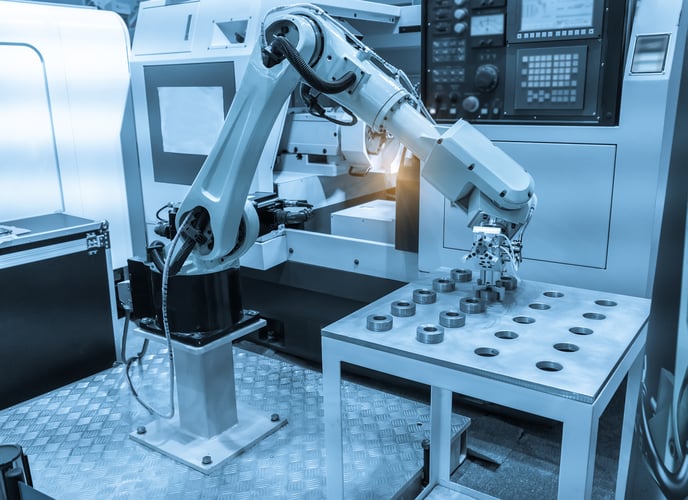
Typical industrial robots are sometimes massive and powerful, requiring security fencing to keep away from hazard to people… a formidable opponent.
Contestant 2: Collaborative Robots
Within the reverse nook, we’ve got the relative newcomer to the automation house: collaborative robots.
Cobots are designed to work alongside people, offering an additional hand on the manufacturing line or for different duties. They’re usually smaller and lighter than typical industrial robots, requiring much less funding of time, finances, and power to get working.
This isn’t the primary time cobots have confronted off in opposition to their robotic cousins. In current many years, they’ve additionally been pitted in opposition to people for his or her security and job consistency. And, usually, people appear happier with this pairing than with typical robots.
Cobots have additionally gone head-to-arm in opposition to one other stunning contender… canine!
Airline Hydraulics not too long ago put cobots up in opposition to a four-legged good friend of their “Pet vs. Collaborative Robotic SHOWDOWN” evaluating how rapidly and precisely they might be taught to talk, fetch, and spin round. It was a detailed name, however the cobot got here out on high!

Let the showdown start!
Each robots and cobots have their strengths and weaknesses.
Typical robots could be extremely highly effective and environment friendly machines, able to executing the identical complicated manufacturing duties repeatedly for months on finish. However they do take a very long time to deploy and are costly.
Cobots, alternatively, are lighter and extra reasonably priced than typical robots. They’re simpler to program and might work safely alongside people. However they are typically slower and fewer robust.
Which can win in our showdown?
Let the competition start!
Spherical 1: Energy
The primary spherical is energy. In relation to energy, industrial robots are typically the stronger of the 2. Some can elevate a whole bunch of kilograms with ease.
Cobots, alternatively, have extra modest lifting capabilities. Even with the heavier payload cobots in the marketplace, such because the UR20 with its 20kg payload capability, it is nonetheless not a lot.
Winner: Robots
Spherical 2: Velocity
In relation to velocity, robots often have the sting and are able to shifting at excessive speeds that no human might match.… but it surely’s not a easy comparability.
Conventional industrial robots often transfer a lot quicker than cobots, permitting them to finish complicated duties rapidly and effectively. Cobots usually transfer slowly, however solely to maintain them inside security limits to be round people. They’re usually able to shifting on the identical velocity as robots.
Winner: Draw
Spherical 3: Flexibility
In relation to flexibility and flexibility, cobots come out on high. You possibly can rapidly and simply reprogram a cobot to carry out quite a lot of duties. Altering between robotic applications and duties can take only a matter of minutes.
With a traditional robotic, reprogramming is often a protracted and tough course of, requiring you to cease manufacturing whereas it occurs.
Winner: Cobots
Spherical 4: Value
The true value of a robotic resolution could be exhausting to make clear. With typical industrial robots, there are numerous added extras you’ll have to pay for that are not at all times apparent up entrance.
Cobots are often extra reasonably priced. Additionally, their ease of use means you needn’t pay costly integration prices to get them up and working.
Winner: Cobots
Spherical 5: Security
That is the spherical the place cobots have an “unfair benefit.”
Conventional industrial robots have to be caged off or required devoted security methods to function safely round people.
Cobots are designed and constructed with human security in thoughts. You possibly can place the cobot into your facility with out security fencing and know that your human employees will probably be secure alongside it.
Winner: Cobots
Spherical 6: Effectivity
In relation to effectivity, this can be a exhausting contest to guage.
What does effectivity imply by way of robotics? What kinds of effectivity are we speaking about, anyway?
There are numerous kinds of effectivity. Typical robots may very well be environment friendly in that they transfer and full duties rapidly. However cobots may very well be environment friendly as they take much less time to program.
Winner: Draw
Spherical 7: Weight
There is no denying it. Industrial robots are heavy beasts. An industrial robotic could be 3 or 4 instances heavier than a cobot with an analogous payload capability.
Heavier doesn’t suggest higher. The upper weight of a traditional robotic means you want a stronger help construction below it and makes it tougher to maneuver the robotic round.
Winner: Cobots
Spherical 8: Accuracy
Typical industrial robots are likely to have the sting in the case of accuracy, and for one purpose… stiffness. Their heavy construction does have one profit — it often makes the robotic stiffer. This will enhance the accuracy of the robotic.
Some cobots are as correct as some typical robots, however on the whole, robots are extra correct.
Winner: Robots
Spherical 9: Ease of Use
The ultimate spherical is ease of use. And right here, cobots clearly come out on high.
Typical industrial robots require specialised programming and upkeep that may be time-consuming and tough for these with out robotics experience.
Cobots are designed to be far more person pleasant. Their intuitive interfaces permit virtually anybody to rapidly learn to program and keep the cobot.
Winner: Cobots
And the winner is…
After a protracted and hard-fought battle, the winner is… cobots!
However there is a caveat…
As with every know-how, the true reply for the query “Which is greatest for me?” is… it relies upon!
In our showdown, cobots might have the sting in components like value, security, and ease of use. However which kind you want will depend on your particular wants. It is as much as you to determine which components are necessary for you.
Regardless of whether or not you select cobots or typical robots, each provide highly effective automation options that may considerably enhance the effectivity and consistency of your duties.
Which choice most accurately fits you? Inform us within the feedback under or be part of the dialogue on LinkedIn, Twitter, Fb, or the DoF skilled robotics group.

.jpg)


0 Comments